Article
Switch Smart: Why Midyear Is the Best Time to Upgrade Your Chiropractic Practice Management Software

The best time to switch chiropractic practice management software is midyear. Summer implementation allows smoother staff training, cleaner data migration, and measurable financial improvements before peak season and year-end deadlines.
If you're waiting until December to switch chiropractic practice management software, you're not just delaying an upgrade. You're actively choosing to lose money, stress out your team, and start 2027 several steps behind where you could be.
The strategic window for switching to ChiroTouch opens between May and August 2026, when your practice has the bandwidth to implement change effectively. This timing delivers three critical advantages: your staff learns without pressure, financial improvements compound over six to seven months, and you completely avoid the holiday chaos that derails year-end transitions.
Let's examine why the "wait until year-end" mentality costs practices thousands in lost revenue, and how you can make the switch without operational disruption.
Why Summer Is the Best Time to Switch Chiropractic Practice Management Software
Summer creates ideal conditions for major operational changes. Patient volumes typically dip slightly, staff schedules remain consistent without holiday disruptions, and your team has mental bandwidth to absorb new workflows.
These factors converge to make May through August the smartest time to implement new chiropractic practice management software.
How Lower Patient Volume Improves Software Implementation Success in Chiropractic Practices
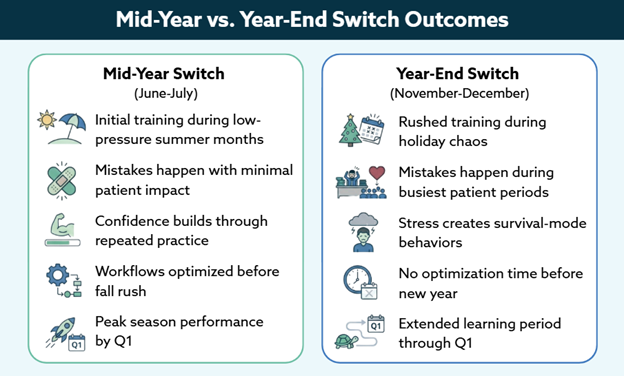
Switching in June or July gives your team two to three months to master ChiroTouch before your practice enters its busiest season. By the time September and October bring increased patient loads, your staff will already feel comfortable with scheduling, documentation, and billing workflows.
This confidence transforms your fall revenue season into productive momentum rather than stressful chaos.
The Financial Case: How Mid-Year Switches Deliver ROI
Generic EHR systems bleed revenue through scheduling inefficiencies, missed collections, and administrative workarounds. A practice seeing 150 patients weekly can easily lose $2,000-$5,000 monthly from these gaps alone. That loss compounds every month you wait.
Sources: [1] MTAC Coalition, Curogram, TransLoc, WhiteSpace Health, Abbadox, MGMA, panaHEALTH, JARALL Medical, HFMA, JAMA Health Forum
Independent reviews of healthcare IT and practice management tools suggest that many practices see double‑digit ROI in the first year, often in the 15–25% range when they use integrated software to cut down on no‑shows, denials, and manual administrative work.
Automated Features That Reduce No‑shows and Billing Errors
Many practices that adopt automated appointment reminders report double‑digit reductions in no‑shows, and ChiroTouch offers similar reminder tools to help keep your schedule full and reduce costly gaps in care.
Its integrated billing and payment features are designed to flag issues before claims go out, support cleaner submissions, and help reduce denials while speeding up reimbursement cycles.
Year‑end Financial Reports Show Measurable Practice Growth
Practices that modernize their EHR and billing workflows often see measurable gains within the first 6–12 months: higher collection rates, shorter accounts receivable cycles, and fewer write‑offs tied to preventable errors.
Those improvements compound over time, giving chiropractors a stronger financial baseline for next year’s budgeting, hiring decisions, and long‑term growth planning.
Training When It Actually Works: Maximize Staff Adoption with Summer's Natural Rhythms
The success of any chiropractic practice management software transition depends on how well your team adopts it—and adoption depends heavily on when training happens. Summer's consistent schedules mean training sessions occur with your full team present.
Nobody misses critical information, and everyone learns the same workflows simultaneously.
Comprehensive Training Programs for Chiropractic Staff
ChiroTouch's comprehensive training programs include on-site training, webinars, and an interactive learning platform—but these resources only deliver value when your team has bandwidth to engage properly.
Every new system brings a learning curve. When that curve happens during naturally lower patient volumes, your front desk can take an extra minute to master a scheduling feature without anxious patients watching. This lower-stakes environment builds genuine competence rather than panicked survival skills.
Workflow Optimization Before Peak Season Begins
The timeline matters for another crucial reason: iterative improvement. Switching in summer provides months to identify workflow adjustments, refine templates, and optimize your use of ChiroTouch features before peak season demands maximum efficiency. You can run reports, analyze patterns, and fine-tune processes when you have time to think strategically rather than simply react.
Why Switching Practice Management Software at Year-End Often Fails
Practices that wait until October, November, or December to switch practice management systems face a perfect storm: learning new software while managing shortened work weeks, handling staff vacation coverage, processing year-end insurance deadlines, and preparing tax documentation.
This cognitive overload leads to mistakes, staff frustration, and patient service disruptions.
The Impact of Holiday Stress on Healthcare Technology Adoption
Research on health IT adoption shows that rushed implementations and training in already high‑stress environments can reduce user acceptance and increase the risk of errors, whereas structured training delivered during calmer periods improves satisfaction and long‑term use of new systems.
Insurance Billing Deadlines and Cash Flow Challenges
December brings critical insurance billing deadlines that can't be postponed for anyone's learning curve. Claims that miss year-end deadlines may not get paid until late January or February, creating cash flow problems precisely when you need strong revenue.
When training gets compressed around holiday schedules, teams learn just enough to survive rather than mastering the system properly. These survival shortcuts often become permanent bad habits that limit effectiveness for months or years.

How Mid-Year Data Migration Protects Your Practice's Most Valuable Asset
Your patient records, billing history, and documentation represent years of accumulated practice knowledge. Migrating this data correctly is non-negotiable for a successful switch, and proper migration requires adequate time.
Best Practices for Transitioning Chiropractic Patient Records
Mid-year implementation allows you to audit current data, identify duplicate patient records, update outdated insurance information, and verify contact details before migration.
ChiroTouch's dedicated onboarding team helps you establish data quality standards that will serve your practice for years. Clean data means staff find patient information quickly, billing runs smoothly without duplicate claim submissions, and marketing efforts reach patients at current contact information.
Data Verification and Quality Control Steps
After migration, verification confirms everything transferred correctly: patient histories are complete, SOAP notes are formatted properly, and billing codes translated accurately. This thoroughness prevents discovering problems months later when they're exponentially harder to fix.
Building Historical Data for Better Practice Analytics
Having six to seven months of ChiroTouch data before year-end means your December 2026 reports will include enough history to identify meaningful trends and make informed decisions.
Practices that switch in December start 2027 with almost no historical data in their new system, making it difficult to set realistic goals or identify emerging problems until months into the new year.
Making the Switch: Your Mid-2026 Transition Timeline for Chiropractic Practice Management
Strategic timing requires strategic planning. Before committing to a switch date, analyze your practice's patient volume patterns over the past two to three years. Identify your naturally slower months, typically May through August for most chiropractic practices, though your specific pattern may vary.
Schedule your switch for the beginning of your slowest eight-week period to maximize training time before volume increases.
Customized Implementation Plans for Your Practice
ChiroTouch's transition team creates a customized timeline respecting your practice's operational realities: scheduling data migration when it won't disrupt patient care, planning training sessions around team availability, and building in buffer time for unexpected challenges.
Patient Communication Strategies During System Transitions
Patient communication deserves attention too. Mid-year implementation provides time to inform patients about upcoming changes to check-in processes, patient portals, and billing statements well before implementation.
A proactive approach prevents confusion and demonstrates professionalism.
The Choice is Clear
Switching to ChiroTouch by mid-2026 positions your practice for exceptional growth in 2027. Or wait until year-end and struggle through the most stressful implementation window while missing six to seven months of compounding financial benefits.
Summer's natural slower pace creates optimal conditions for staff training, thorough data migration, and system mastery before your busiest season arrives.
So why wait? Schedule a personalized demo to see how ChiroTouch helps chiropractors upgrade their practice management software without disrupting patient care today, and beat the end-of-year rush. While others are getting used to their new chiropractic practice management softwar in January, you’ll be seeing a steady ROI.
You can count on ChiroTouch
The complete integrated chiropractic software for all your practice needs.
FAQs
When is the best time to switch chiropractic practice management software?
Why is switching practice management software at year-end risky?
How long does it take to implement new chiropractic practice management software?
How does switching software impact revenue growth?
Adler‑Milstein, J., Holmgren, A. J., Kralovec, P., Worzala, C., Searcy, T., & Patel, V. (2009). A framework for predicting EHR adoption attitudes. Journal of Healthcare Information Management, 23(2), 15–22. https://pmc.ncbi.nlm.nih.gov/articles/PMC2804456/
Adler‑Milstein, J., et al. (2022). The value of electronic health records since the Health Information Technology for Economic and Clinical Health (HITECH) Act. Health Services Research, 57(S2), 174–192. https://pmc.ncbi.nlm.nih.gov/articles/PMC9555331/
Abbadox. (2022, April 10). Patient no‑shows cost medical practices over $150 billion annually. Abbadox. https://www.abbadox.com/blog/patient-no-shows-cost-your-practice
CollaborateMD. (2025, November 23). Healthcare revenue cycle optimization. CollaborateMD. https://www.collaboratemd.com/blog/healthcare-revenue-cycle-optimization/
Curogram. (2025, May 28). How much each year do no shows cost the U.S. healthcare system? Curogram. https://curogram.com/blog/how-much-each-year-do-no-shows-cost-the-u.s.-healthcare-system
Healthcare Financial Management Association. (2021, June 7). Study quantifies the cost to physician practices of participating in the MIPS program. HFMA. https://www.hfma.org/payment-reimbursement-and-managed-care/macra/study-quantifies-the-cost-to-physician-practices-of-participat
JARALL Medical. (2026, January 28). How denial reduction impacts monthly revenue in podiatry practices. JARALL Medical. https://jarallmedical.com/how-denial-reduction-impacts-monthly-revenue-in-podiatry-practices/
Medical Group Management Association. (2021, March 2). No show appointments: Why they happen and how to reduce them [Fellowship paper]. MGMA. https://www.mgma.com/fellowship-papers/no-show-appointments-why-they-happen-and-how-to-reduce-them
MTAC Coalition. (2017, April 25). Missed appointments cost the U.S. healthcare system $150B each year [Data point]. MTAC Coalition. https://mtaccoalition.org/nemt_data_point/missed-appointments-cost-the-u-s-healthcare-system-150b-each-year-data-point-1/
panaHEALTH. (2025, June 1). The hidden cost of denied claims: How much revenue are you leaving on the table? panaHEALTH. https://www.panahealthcaresolutions.com/blogs/the-hidden-cost-of-denied-claims-how-much-revenue-are-you-leaving-on-the-table/
Perfect Patients. (2024, June 16). 5 summer strategies to attract new chiropractic patients. Perfect Patients. https://www.perfectpatients.com/summer-strategies-for-more-new-chiropractic-patients/
Prospyr. (2025, May 15). How automated reminders reduce no‑shows. Prospyr. https://www.prospyrmed.com/blog/post/how-automated-reminders-reduce-no-shows
Qiaben. (2025, March 26). How to optimize mid revenue cycle services for more profit. Qiaben. https://qiaben.com/how-to-optimize-mid-revenue-cycle-services-for-more-profit/
Ruotsalainen, S., et al. (2021). Electronic health record implementations and insufficient training: A longitudinal study of perceived stress related to information systems. Journal of Medical Internet Research, 23(12), e29870.https://pmc.ncbi.nlm.nih.gov/articles/PMC8738988/
TransLoc. (2024, September 18). The cost of missed medical appointments: A hidden burden on healthcare. TransLoc. https://transloc.com/blog/the-cost-of-missed-medical-appointments-a-hidden-burden-on-healthcare/
WhiteSpace Health. (2025, June 30). No‑shows and cancellations negatively impact provider utilization and practice revenue. WhiteSpace Health. https://whitespacehealth.com/blogs/no-shows-and-cancellations-negatively-impact-provider-utilization-and-practice-revenue/
zHealth. (2025, July 27). Financial planning 101 for solo chiropractic practices. zHealth. https://myzhealth.io/blog/financial-planning-for-solo-chiropractic-practices/
zHealth. (2025, October 12). How smart chiropractors are winning with online scheduling tools. zHealth. https://myzhealth.io/blog/how-smart-chiropractors-are-winning-with-online-scheduling-tools/

Trusted chiropractic experts rooted in innovation and growth, driven by unmatched chiropractic software expertise.
Designed for chiropractic practices
ChiroTouch was intentionally designed specifically for cash and insurance billing practices like yours.